
Dating the massive silver chains of Pictland
In which I look at all the issues and concerns about dating the chains

Having looked at the findspots of the silver chains, and discovered that they appear to be guarding entrances to regions, on the estuaries in Pictland, and on routes and junctions in Lothian, I think it’s time to have yet another look at the dating of the silver chains.
The high level of silver
Although it doesn’t seem all the silver chains have been recently tested for their level of purity, it is generally agreed that most if not all silver chains have a very high level of around 95% silver, the same level found in good quality Roman silver items.
We also know that silver coming into Pictland was subsequently diluted over the years to make it stretch further, once the source of Roman silver had dried up in the 400s. Even before the Romans left Britain, they had been having trouble meeting their silver needs, resulting in a dilution of the silver content of their coinage.
Interestingly, Roman silver was largely mined in Spain. And it was then used to buy goods like silk coming in from China. The empire was leaking silver fast.
We can assume then that the silver of the chains was sourced during the later Roman years, or as raided goods in the years immediately after the Romans left. And, we can assume that the chains were made almost immediately after the silver was sourced, as there is little to no dilution of the silver. So, we’re looking at a date from AD 300 to 450 thereabouts.
This general dating is currently accepted as a first line.
Raid, trade, or paid?
Hoards of silver, and the massive silver chains, have questions over how this Roman silver came to be in Pictland, and this question has relevance for dating.
Hoards tend to be composed of hack silver – silver hacked into pieces to deliberately conform to a system of weights. These can be thought of as payments for services rendered – either as mercenaries, or help in defending borders. A scenario for this could be protection money from native British elites, rather than central Roman authorities, as the empire crumbled and then collapsed. The PAID option.
Given that we find a bronze chain and carvings of dogs wearing a chain collar at Caerleon on the Severn Estuary, it’s a fair possibility that either the Picts or the Votadini were mercenaries. If the silver is connected to this military service, they weren’t paid in silver coins as was the usual case for the Roman army, as the denarii by this later stage weren’t of the required purity of the chains. Nor do we find any other evidence for a lot of denarii coming into Pictland after AD 200. To accept that the chains came from military payments, we’d have to propose that they were paid in hack silver, which seems a little odd.
The TRADE option is one that we have little to no evidence for, but which is a distinct possibility. Both areas of the chains, Lothian and Aberdeenshire/Buchan/Moray, are good cereal production regions, and the Roman army was always in desperate need of grain to feed their troops. Grain for hack silver makes good sense.
The RAID option is also possible. Both the later years of Roman Britain, and the years immediately following their withdrawal, saw a number of recorded ‘barbarian’ incursions. Could raiding parties collect enough silver to make the chains? It seems unlikely that a smash and grab raiding party could focus enough on finding large amounts of silver. But there is another possible scenario, that the Picts and Votadini took many hostages on their raids, and then received payment for their release. This scenario is supported by finding hack silver with Christian motifs in the Traprain Law hoard. According to church law, Christian silver vessels were only allowed to be destroyed for this for one reason – buying the release of Christian hostages.
These options of raid, trade, or paid, all seem to point to the later Roman years. The connections to Caerleon are in the early part of the 300s, before the Romans deserted this major camp. Trade in services or grain would have been at their height in the 300s too. Raiding was sporadic, but may point to a slightly later period of the late 300s into the mid 400s.
The form of the silver chains
One of the interesting aspects of the silver chains is that they were all made to a fairly strict pattern.
They are of nearly identical length, within only a couple of centimetres difference. The size of their links varies a little, which means that a different number of links is required to make the chain of the required length.
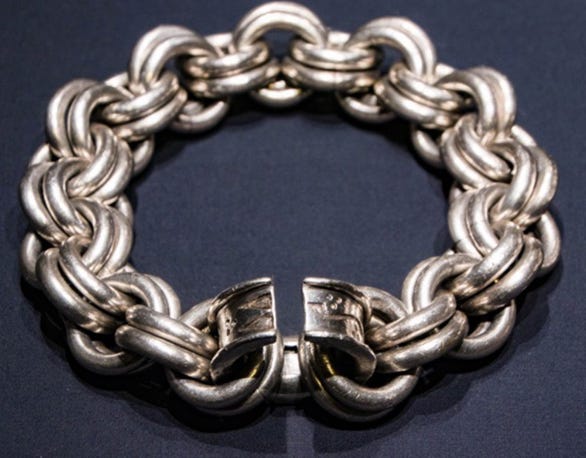
A chain is composed of a series of double links, with a pair of links slightly larger at one end, and a single larger link at the other end. A flat clasp with an opening is at the double-link end.
The same style of chain but in bronze is found at the High Pasture Cave on Skye, and at the permanent Roman fortress of Caerleon. These chains are much smaller, and much earlier, early 300s for Caerleon and 790 – 539 BC for Skye, meaning that the philosophy behind these chains has a lengthy history.
The long history of these chains is also supported by the Irish stories which tell us that they were made either of silver or findruine – bronze with a tinned coating that appears to be silver. Findruine is found in archaeological contexts prior to the influx of Roman silver, or as an alternative to the real thing when unavailable. The history here feels like the Picts were suddenly able to make a real ‘silver chain’ according to their legends, and when the opportunity arose, they took it.
This standardised form of massive silver chain indicates that someone, one day, decided to materialise a story, and created these chains all with a near identical pattern, shape and form, but now in ‘real’ silver, and appropriately super large for a deity. In other words, it’s beginning to seem likely they were all made at the same time. Or, at least within a generation by the same school.
The purpose of the silver chains
As my previous blogs have discussed, the silver chains all seem to have been deposited in similar contexts, with the primary purpose of guarding the land. In Lothian, they were deposited at the power centres of Traprain Law and Edinburgh, then at the entrances and junctions of routes heading north into Lothian. In Pictland, with only one possible exception, they sit near the estuary of major river systems, and on borders between regions, again guarding entrances to the land.
But, here’s the most interesting thing about this distribution - it’s coordinated. The findspots aren’t random. It’s like someone has sat down with a map and asked, where do we need to deposit a silver chain? Then gone about making and depositing them in one ‘silver chain event’.
Once again, the logic seems to be that the chains were made as a group, to be deposited as a coordinated group. Which means that their dating is going to be very tight indeed. All we need to do is discover what event brought in so much silver, and what event or decision led to the need to protect the land with such extravagant gifts to the gods.
Previous dating concerns
The dating of the silver chains to around AD 300 to 450 has only recently been accepted. But frankly it’s always been obvious. Everywhere else in the world happily gave their silver hoards this timeline, only in Scotland were they previously claimed to be from many centuries later. So why all this angst?
The answer lies in the fact that two of the chains carry Pictish symbols. And the dating of Pictish symbols has been the hairiest story of them all. It is only in recent years that the date of the earliest symbols has been significantly pushed back by archaeologists.
Prior to the archaeological dating, James Fraser, in From Caledonia to Pictland p. 114, writing in 2009, said this:
In fact, the prevailing art-historical argument maintains that the symbol stones significantly post-date Christianisation, even if the symbols themselves developed earlier. As such, they speak of the persistence of cultural traits of a certain kind in southern Pictland, from the Roman Iron Age through the Early Historic period. There is no reason to link them with pagan religiosity.
The religious agenda as a driving force in dating the symbols is clear from that statement. Many people, just 20 years ago, believed that all symbols came from the 9th to 10th centuries, putting them safely into ‘real’ Roman Christianity. Gradually, slowly, painfully, archaeology has pushed the dates back, 8-9th C, to 6-7th C, to 3-4th C. And the story isn’t over yet. The earliest symbols identified so far are informal ones on cave walls, but they are already fully formed with governing rules, indicating that the symbols themselves come from much earlier again.
The problem hasn’t really been that we didn’t have a good handle on the date of the symbols, but rather that other people took as fact the dating as current in their day, and then used it to interpret their own archaeology and history. And this was what happened to the dating of the silver chains. Their dates were pushed out into later centuries – because the symbols they carried must be from a later date.
There have been a few brave scholars who questioned this decision. Cummins in his book ‘The Picts and their Symbols’ p.82-97 discusses the silver chains and places them in their logical timeline and context. Laing also questioned the dates. Only with the recent exhibition of silver was the dating silently, without comment or acknowledgement, re-aligned.
But as we will see, this still remains an issue to some degree. Miller in his thesis, just this year of 2025, while accepting that the chains were probably early, suggested that the clasps with symbols could be much later additions. In doing this, he separates the dates of the clasps with symbols from the dates of the chains.
We need to look more closely at the symbols on the chains, to try to discover how their dating may be playing out.
The symbols on the clasps
Two clasps carry Pictish symbols. Most writers present this as an exception, implying that most clasps didn’t carry symbols. But that’s not the case.
Of the 15 silver chains found, only 9 remain to us today. Of these 9 chains, only 5 have clasps surviving - 2 with symbols, 3 without symbols.
In other words, we don’t know how many of the other 10 chains originally carried symbols. All of the chains inside Pictland have lost their clasp, except the Parkhill chain with its symbols, so it’s entirely possible that all Pictish chains originally carried symbols.
Three of the eight Lothian chains have clasps without symbols, and this ties in with the lack of symbol stones in the area.
The one outstanding question though is why the Whitecleugh chain found so far south also carries symbols. It seems likely, given their link number, and their type of clasp, that the Whitecleugh and Parkhill chains were made by the same hand. I have no ready answer for this, except to say the ownership of all the Lothian chains remains a question.
The symbols on the Whitecleugh chain
The Whitecleugh chain has two recognisable symbols, the double-disc/Z and the notched-rectangle (without a rod).
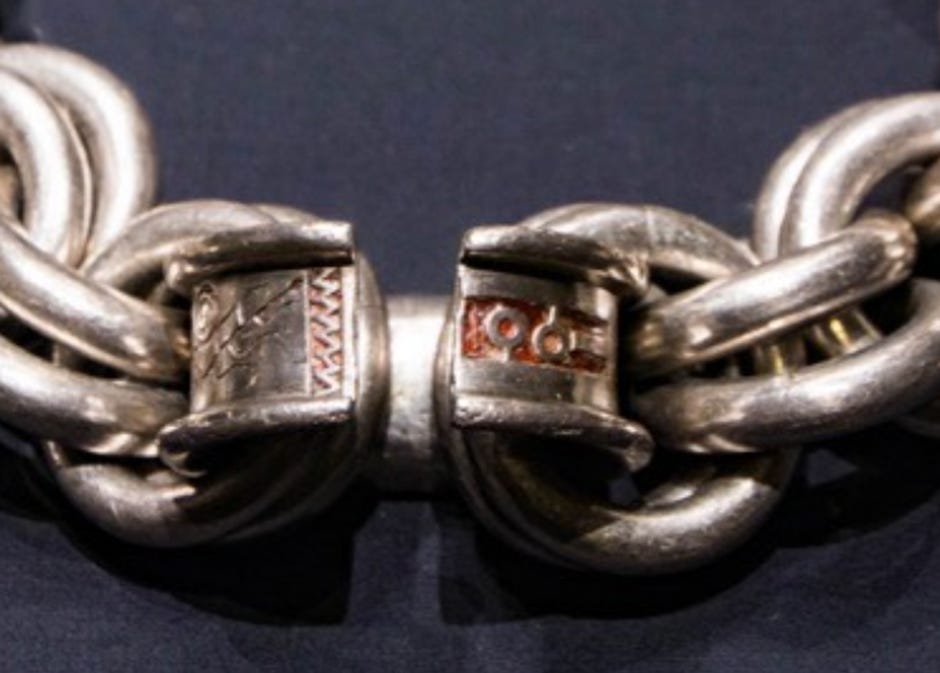
We can tell that each symbol has its upper end at the break in the clasp. The double-disc/Z symbol always has the end with the five floriations on its rod pointing to the top of the symbol.
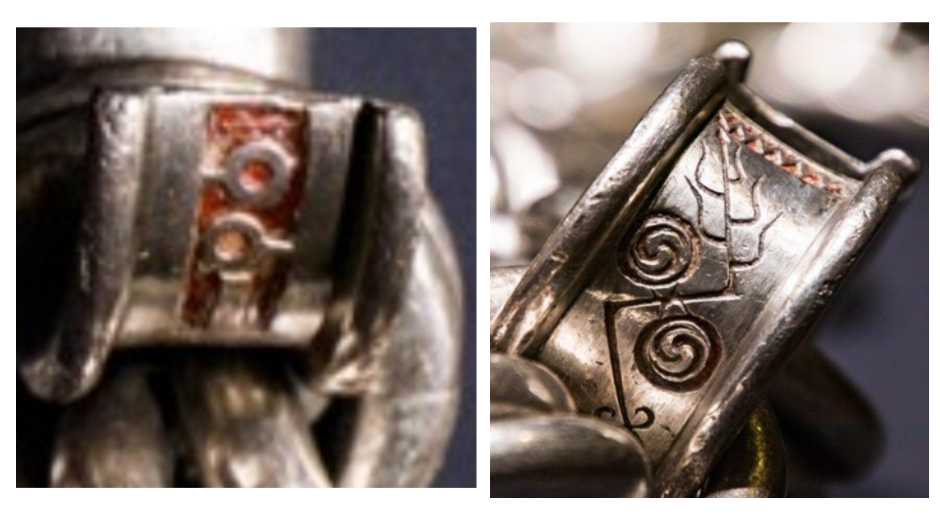
And we can also tell that these two symbols are acting as a pair, the usual case for symbols - because the notched-rectangle has no Z rod.
Symbols are drawn from an ordered list, and occur in their pair in the same relative order as on the list. In this case, the notched-rectangle is above the double-disc/Z.
But, in a symbol pair, one of the symbols holds what I have called ‘dominance’ over the other. Usually this is the upper symbol, in this case the notched-rectangle. But if, for some reason particular to a stone or artefact, dominance is needed to go to the second symbol, one way to do this is for the upper symbol to lose its rod, which is why the notched-rectangle on the silver chain has lost its Z rod – it is handing dominance to the lower symbol, the double-disc/Z.
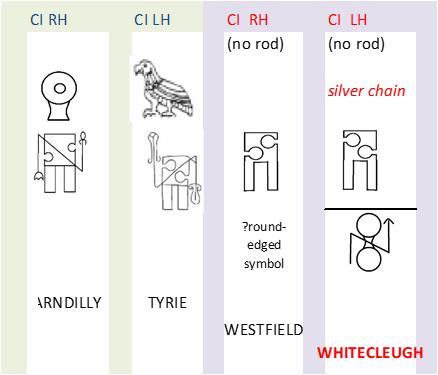
There is only one other instance of a notched-rectangle without its Z rod, on a symbol stone fragment at Westfield below East Lomond Law in Fife.
Nor is there any other instance of these two symbols in a pair, despite the double-disc/Z being a high-frequency symbol at around 10%. This means that, although both symbols are frequent and well-attested, the symbol pair on the Whitecleugh chain is quite an unusual choice.
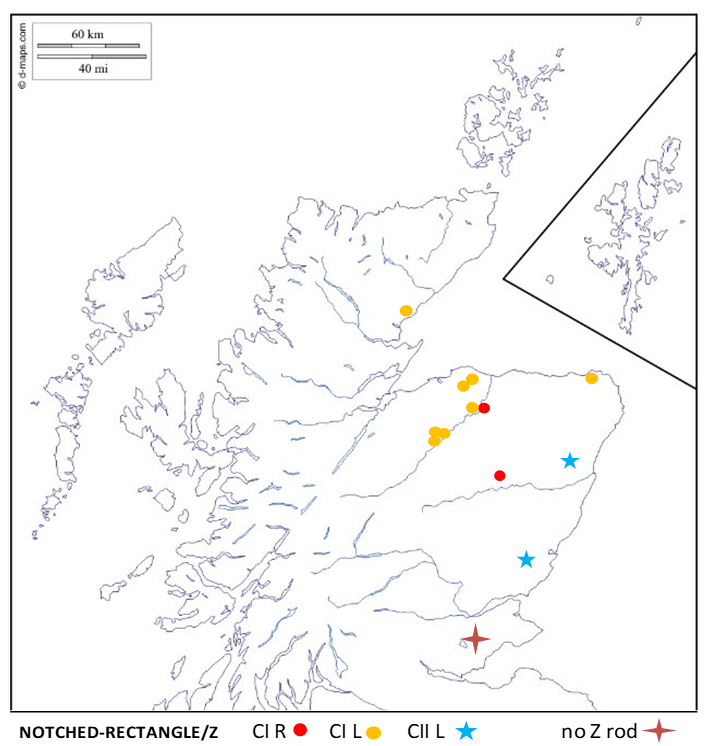
The notched-rectangle symbol mostly occurs in the north, in the Spey valley and Moray coastal region. The Whitecleugh and Westfield symbols, both uniquely without their rod, are the only CI instances that occur below the Mounth.
On CI stones, the double-disc/Z has a focus in the Aberdeenshire region, from Aberdeen through to Rhynie. It does however have a wide scatter elsewhere, even if not so concentrated. This means that the Whitecleugh chain holds two symbols that both have a focus in the same northern region as the Pictish silver chains – another pointer to the southern chains being part of the same ‘silver chain event’ as the northern chains.
The symbols of the Parkhill silver chain
The Parkhill silver chain has two symbols on its clasp – the ogee and ‘two triangles’. The ‘two triangles’ is not known from any other example, but we do have a number of other symbols which only occur once, and we don’t know how many symbols are not attested at all, so there is no reason to think this is not a valid symbol.
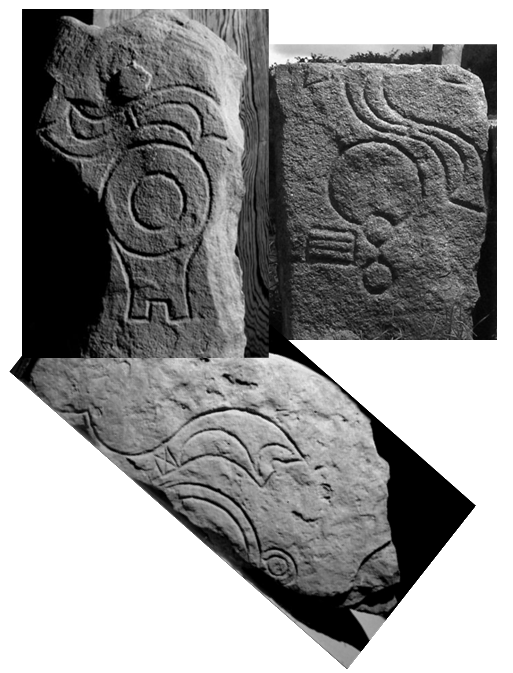
The ogee symbol is rare, only found on three CI stones, two at Kintradwell near Brora, and the other at Drimmies, upstream of Brandsbutt, ABD.
It’s possible that most of the northern symbol stones, like the two from Kintradwell, are part of a later Pictish expansion into the region, although it’s hard to be precise here. The Drimmies stone is a later CI stone, as shown by its double-sided comb. This possibly means that all these ogee examples on symbol stones may well post-date the silver chain.
So, the symbols on the two chains don’t really help us with dating the chains as such. But they are interesting in their own right, the Parkhill chain has two rare symbols, and the Whitecleugh chain has a unique combination of symbols.
The case of red enamel
The symbols on both chains are filled with red enamel. Scotland’s Early Silver says that this may date the chains to the 300s. Miller, on the other hand, says that red enamel was early, and during the Roman years other colours such as blue and yellow were added to red, but with the withdrawal of Rome, red enamel once again becomes the norm. From this, he falls on the side of thinking the clasps with symbols are much later in any dating sequence, and that the symbol clasps were made later than the chains, perhaps ‘as much as 300 years later’.
The issue is we only have these chains, the Norries Law plaque, and a couple of hand-pins, with red enamel, so the data is too rarified to draw a general pattern through time, especially as the use of red enamel is a constant over the centuries. In addition, the Picts in several ways show that they are not falling in line with Roman fashion. I don’t think the red enamel can help us with more a precise dating for the chains.
Keeping the chains for centuries before burial
If, as Miller suggests, the date of the chains may be separated from a considerably later date of the clasps with symbols, there is an implication that the chains were used as some kind of regalia, and held above ground for many centuries before being buried. However, I would expect after several centuries of usage wear patterns would be fairly obvious.
I also come back to the fact that the chains were not wearable regalia fit for a human, but symbolic chains with immense mythic power. And, that they were all deposited in a coordinated pattern over northern Pictland and Lothian, a pattern we wouldn’t expect to find if they were randomly buried after several centuries of usage as regalia. The function of the chains as shown by their deposition sites is to guard the entrance to a region, and the logic here is that they were all made, and deposited, with a clear purpose, to perform a critically important ritual role, in coordination, at the same time, ‘the silver chain event’.
The La Tene style internal decoration
The dating of the silver chains to AD 300-450 thereabouts puts the chains into the pre-Christian period, or at least into the period before Christianity took hold in a political sense. So, we might expect the symbols on the chains to be similar to pre-Christian Class I symbols, but they’re not.
I have to confess to having triggered this bit of chaos – when I pointed out that the double-disc/Z on the Whitecleugh chain, and on the Norries Law plaque, do not have the type of internal decoration that we expect of a Class I symbol. We seem to have a silver chain from the Class I period, but with symbols that may be from the Class II period. It’s a quandary, which I guess I should try to fix as I started it.
We have loads of examples of the Class I double-disc/Z symbol. All of their discs are divided with at least one internal circle, usually in turn with a central dot.
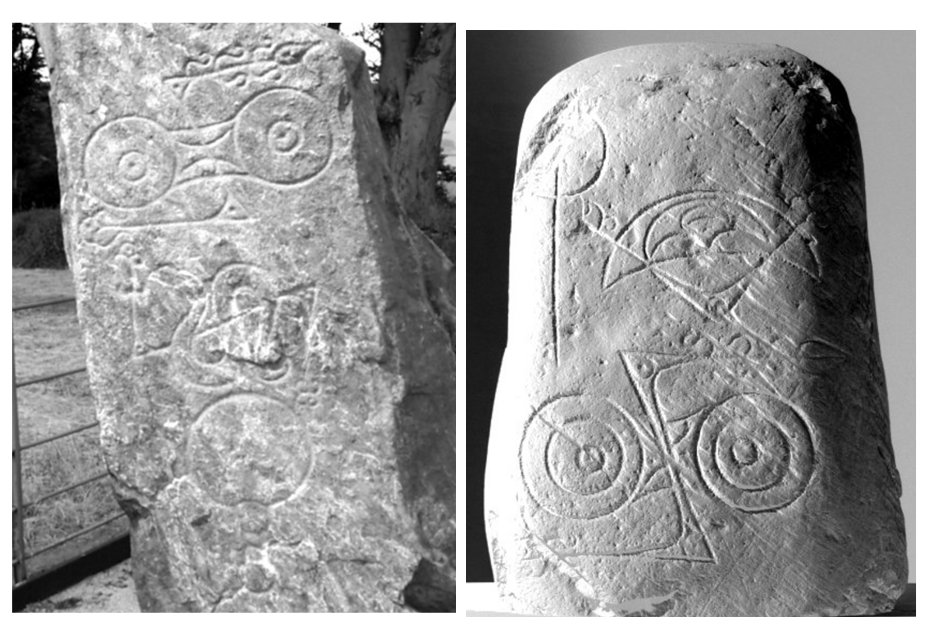
When we get to Christian Class II examples, this internal circle is lost completely, and the discs are filled with a few different patterns. And one of those patterns is what George Bain in Celtic Art: The Methods of Construction p59-62, calls the ‘three-coil spiral’.
The double-disc/Z of the Whitecleugh chain has a two-coil spiral, but the Class II double-disc/Z of Strathmartine 5, Ulbster, Meigle 2 and Kirriemuir 2, all have three-coil spirals. The three-coil spiral also occurs within other CII symbols and other decoration, for example, the ‘sunburst’ of Hilton of Cadboll.
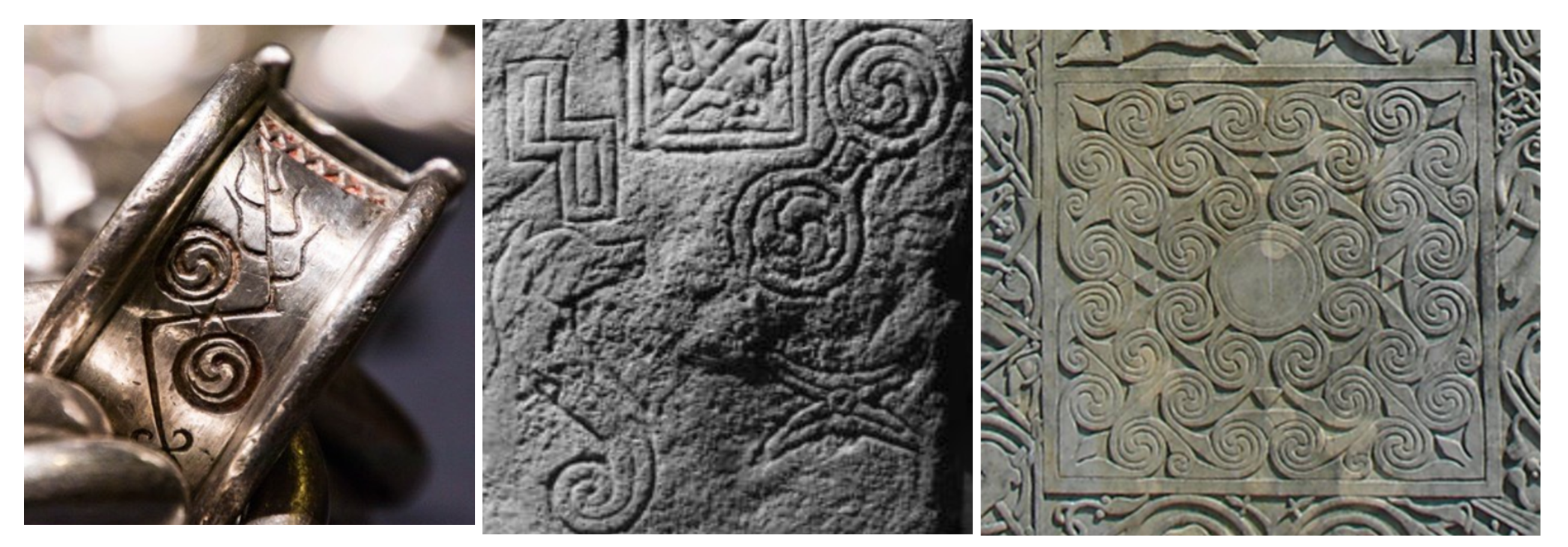
These spirals are not found on any Class I stones, but they are one of the most basic circular forms of La Tene art. And while La Tene art flourished in the years BC, elements of it still persisted for centuries, and can be found in manuscripts such as the Book of Kells and the Book of Durrow, although it must be pointed out that this is rare.
The Gaulcross pin also has the three dots decoration found on the Parkhill chain, again tying them together.
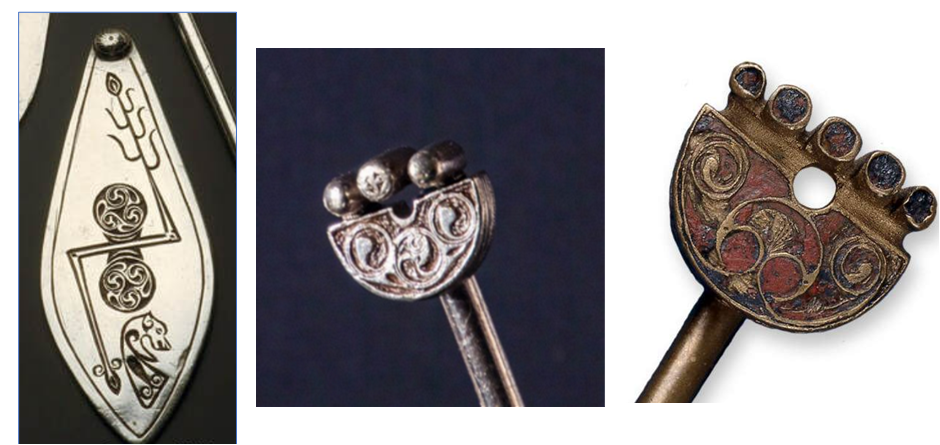
I was hoping that the silver pins with La Tene style artwork might help with a more precise dating as they are found over Britain and Ireland, but every paper I opened said the same thing - it’s just too hard to pin down a precise dating context. Proposed dates for this sort of pin range from the 3rd to 7th centuries. Which isn’t terribly helpful.
Dating Class I and Class II symbols
Where does that leave us with dating the silver chains?
Filling the discs of the double-disc/Z is definitely a form found only on Class II stones. So, unless putting a symbol on metal was considered differently, we should place the Whitecleugh symbol, and the Norries Law plaque, into a Class II context.
But at the same time, the style of La Tene art on this group of silver items suggests we are in an earlier phase of artwork than that of most Class II stones. The dating of the silver chains and their symbols would seem to be right at the point where Class I artwork is giving way to what will eventually become Class II artwork, but is still ancient La Tene style.
And this is where the difficulty lies. How do we date the Class II period?
We can safely date the final flourishing of stones such as Hilton of Cadboll to the 700s, as the Portmahomack monastery was destroyed around AD 800. But when did the period start?
It is likely that the Class II stones began to be raised in the period when the political class formalised the practice, which happened in the second half of the 500s in Ireland, and in the first half of the 600s in Northumbria. That’s my best guess.
But, from the very start of the Class II stones, they displayed quite significant changes in their artwork. A new style of cross peculiar to Pictland, interlace, key pattern, and symbols filled with different decorations, including the double-disc/Z with triple-coil spirals that we’ve seen above. There is no gradual change here, it has already happened before the CII stones begin. We seem to be missing the period of this shift in artwork from CI to CII. A shift which presumably happened on unattested metalwork, wood, or documents, well prior to the AD 500s/600s of the CII symbol stones. Which puts the silver chains into this interlude.
Similarly, there is a problem with dating the Class I symbol stones, which is especially obvious in southern Pictland. Here the symbol stones have a single-sided comb, the ancient Celtic type. But all the Class II stones carry a double-sided comb, the new Roman fashion. What this tells us is that there is a significant time lapse in the south, between the last Class I stone being carved and the first Class II stone being raised with its new styles of art and symbols. And the silver chains with their peculiar symbols fit within this strange interlude.
So now we can ask the question from the other direction – can we date this time interlude in the south? The answer I suspect is obvious, that this is the same interlude we find in the archaeology, from the early 200s onwards for two or three centuries, when population numbers decline severely. And remembering that the south isn’t just missing symbol stones from this interlude, but also it has no known silver chains.
Pulling the dating together …
To sum up, this is what we have so far. The silver chains themselves can be dated from around 300 to 450 thereabouts. The symbols on the clasps, along with those on the Norries Law plaque, seem to come from somewhere after 200 to before 500, but probably closer to the earlier date, while new art styles were being developed on silver items.
In other words, there is no reason to be concerned that the symbols of the chains were not the usual form of Class I symbol, as art styles had already begun to shift, possibly in the 4th century. This period seems to be a time when so much of the Pictish world was changing, under stress from the Roman presence and its decline.
An unexpected aspect that has come out of this research is that all the massive silver chains seem to have been made, and ritually deposited, at one time. They were all made to quite a standard size, and in the same form. Elements, such as the clasps, number of links, and length seem to tie chains to the same maker. The chains were deposited in such a coordinated manner over part of Pictland and Lothian, that it appears their manufacture and immediate deposition are part of the one ‘silver chain event’.
The silver chains belong to a long-standing myth centuries old, but the sudden opportunity to gather enough silver to make an enormous chain suitable for a deity in order to call upon his protection for the land, that was a major change. The symbols themselves were ancient, likely created in the centuries BC, but now they could be put on stone, and on the great silver chains. The rules of the symbols and their sacred outward form were held steady. But now their internal decoration could express other ideas - first simple geometry, then filled with ancient La Tene artwork in all its glorious swirls on silver, then intricate interlace and key pattern on the Christian stones. Some things would always remain the same, other things were allowed to evolve and fly.
And sorry, this doesn’t really pin down the dates of the chains and their clasps with symbols to any greater precision than what we started with, from the 300s to mid 400s. But, at least we can be happy we didn’t find anything to gainsay that!
*My great thanks to Bill Patterson for his scholarship, constant advice and input into this research. Errors or oddities all mine of course.
Very interesting. You mention trade in grain, is there any evidence of this from places like Dunnicaer, which is early in the currently acknowledged Pictish period and has evidence of contact, so possibly trade, with Rome?
Fantastic article and very thought provoking as always.